
Clinically needed dental X-rays and appropriate local anaesthetic can be used during pregnancy. The dentist should explain why a test or injection is needed and choose an approach suited to you. Pregnancy is not, by itself, a reason to postpone necessary diagnosis or carry out painful treatment without adequate numbing.
Why might I need a dental X-ray?
An examination cannot reveal everything beneath a filling, between teeth or around a root. An indicated image can help assess decay, infection, trauma or the planning and completion of treatment. Avoiding it may leave an important question unanswered.
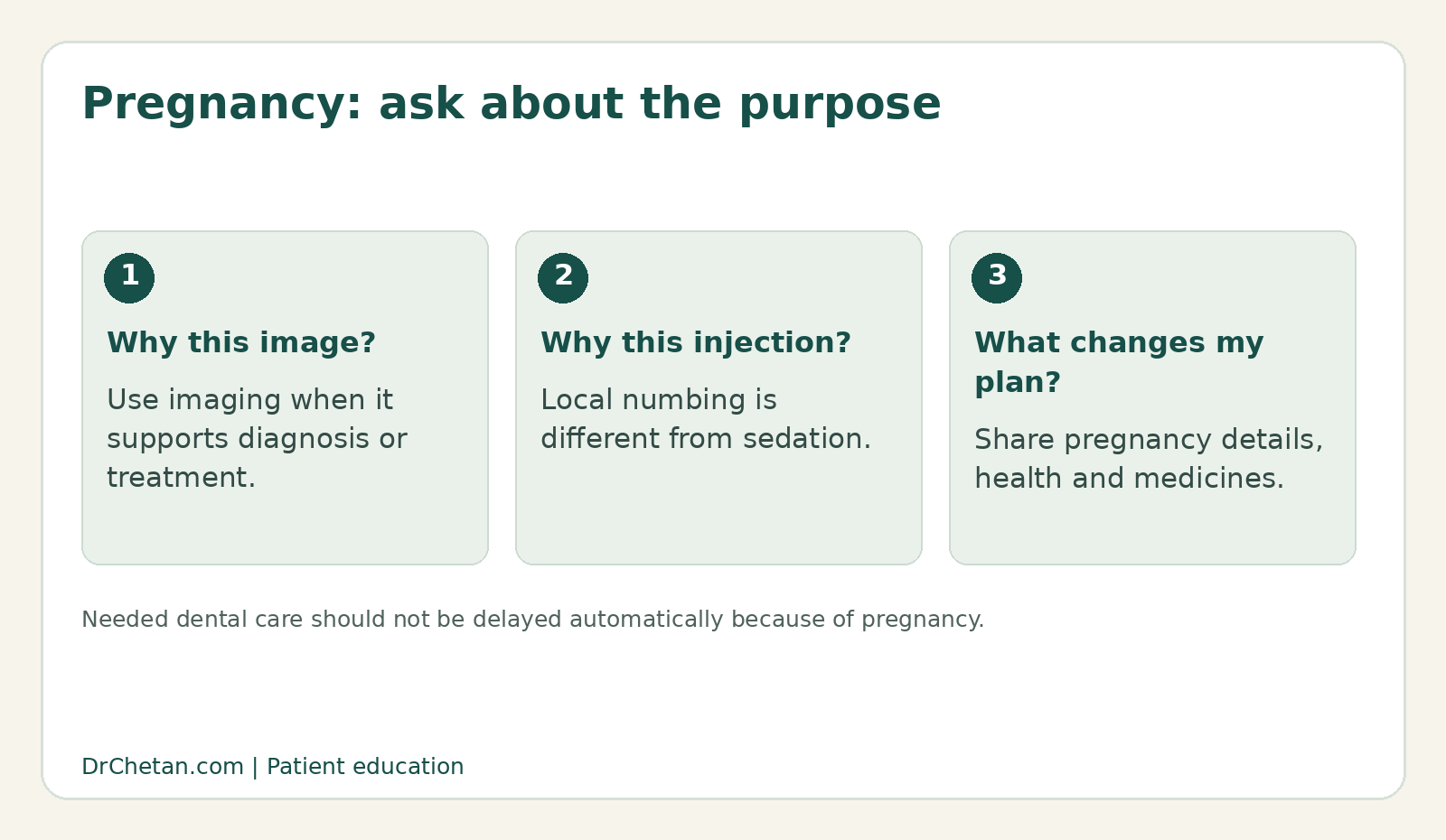
That does not mean every pregnant patient needs imaging at every visit. The decision follows the history, examination and available earlier images. Ask, “What information will this image provide, and would it change today’s care?”
How is exposure kept low?
The X-ray beam is directed at the teeth and jaws, not the developing baby. Appropriate equipment, a limited imaging field, correct positioning and avoiding unnecessary repeat images help reduce exposure. The clinician selects the type and number of images according to the diagnostic question.
A small intraoral image, a panoramic image and a cone-beam CT scan are different examinations. A scan is not automatically better or required. If a more extensive image is proposed, ask why it is justified and whether an existing image or another approach could answer the question.
Safety discussions should reflect the very low exposure from appropriately performed dental imaging without claiming that all radiation exposure is literally zero. Your team can explain the balance between the small imaging risk and the benefit of diagnosing and treating the problem.
Do I need a lead apron or thyroid collar?
Current ADA and AAOMR recommendations no longer advise routine abdominal or thyroid shielding for dental patients, including pregnant patients. Modern protection focuses on selecting justified images and limiting the beam. A shield can sometimes obscure the image and lead to a repeat exposure.
Local radiation rules and practice protocols still apply, so you may see different approaches between clinics. The presence or absence of an apron is not the only measure of whether imaging is appropriate. Ask the dental team to explain its protocol if you are concerned.
What should I tell the team before imaging?
Say that you are pregnant, might be pregnant or are trying to become pregnant, and share your estimated gestational stage. Tell the team about previous dental images if you have them. This supports an appropriate discussion and care plan; do not cancel assessment just because you are uncertain about dates.
If you had a dental X-ray before realising you were pregnant, contact your dentist or obstetric clinician with the details rather than assuming harm occurred. They can explain the actual exposure and whether any further advice is needed.
Can I have a numbing injection?
Local anaesthetic blocks sensation in the area being treated. It is different from medicine that makes you sleepy or from general anaesthesia. Lidocaine, with or without adrenaline, also called epinephrine, can be used when clinically appropriate during pregnancy.
The dentist chooses the preparation and dose in light of the procedure and your health. Adrenaline in a dental anaesthetic is not automatically prohibited because of pregnancy. Conversely, no medicine should be described as suitable in every dose or for every medical situation.
Share allergies, previous reactions, heart conditions, pregnancy complications and all medicines. If an earlier injection made you feel faint or caused a racing heart, describe what happened; that history needs assessment rather than an assumed allergy label.
Is it safer to avoid anaesthetic and tolerate pain?
Not necessarily. Painful or incomplete care is not a useful safety goal. The team should check that numbing is adequate and adapt the technique when needed. Agree on a hand signal so the dentist can stop if you feel sharp pain.
Temporary numbness of the lip or cheek can remain after the appointment. Avoid biting the numb tissues and take care with hot food and drinks until normal sensation returns.
What about sedation, gas or general anaesthesia?
These are separate decisions and cannot be treated as equivalent to an ordinary local injection. The need, medicine, alternatives, setting and pregnancy circumstances require specific assessment. Routine reassurance about local anaesthetic does not automatically approve every sedation technique.
If you are highly anxious, say so when booking. The team may adapt the visit, explain options or consult your obstetric clinician. Do not take someone else’s sedative or assume you should fast unless the treating service gives explicit instructions.
How do I decide what to do next?
Ask the dentist to explain the problem, what the proposed test or anaesthetic makes possible, the alternatives and the implications of delay. For an uncomplicated pregnancy, routine dental care does not generally require a universal permission letter; specific medical concerns may warrant coordination.
For broader daily care, see dental care during pregnancy. Severe pain, fever or swelling deserves prompt dental advice; swelling affecting breathing, swallowing or the eye requires emergency assessment.
Frequently asked questions
Must all dental X-rays wait until the second trimester?
No. Needed dental imaging can be performed at any stage. Timing is based on clinical need and the individual plan.
Does an X-ray leave radiation in my body?
No. Ordinary diagnostic dental X-rays do not make you radioactive.
Can my obstetric clinician help with a medicine concern?
Yes. Your dentist can coordinate with them or a medicines pharmacist when the situation requires it.
References and further reading
- ADA: Pregnancy
- ADA: X-rays and radiographs, including updated patient-selection guidance
- ADA: Updated recommendations on dental radiography safety
- AAOMR: Pregnant patients and dental imaging brochure
- Guy’s and St Thomas’ NHS: Dental X-rays
- ADA MouthHealthy: Pregnancy dental concerns
- LactMed: Diagnostic X-rays
Sources checked 2 November 2026. This is general patient education; an examination and an individual treatment plan may be needed.

Leave a Reply