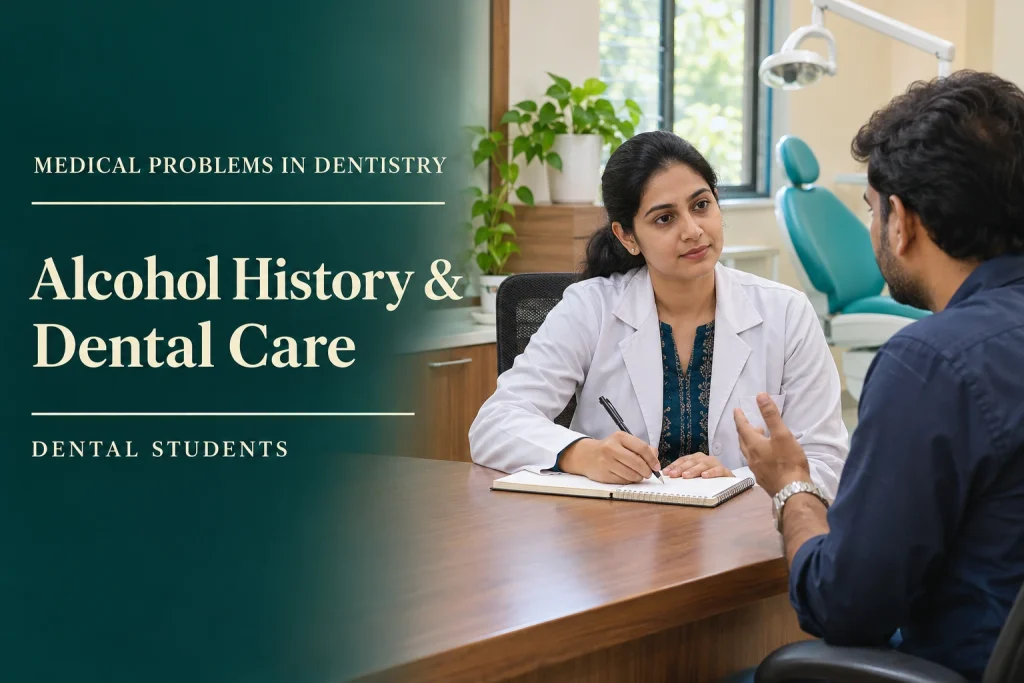
Medical Problems in Dentistry: Article 122 of 215 · Substance use and dependence · Complete student guide
Medical Problems in Dentistry · Student guide
Alcohol history matters to dental assessment because current intoxication, withdrawal risk, organ disease and medicine interactions can change the plan. Students should ask respectfully, identify the immediate problem and know when medical support is needed. A dental visit is an opportunity to improve access to care, not to judge the patient.
In this guide: Learning objectives · Start with this clinical case · Ask about patterns rather than accepting “social drinking” · Recognise dependence-related withdrawal risk · Escalate a concerning current presentation · Assess organ disease and prescribing together · Separate common care situations · Offer a useful referral and keep dental follow-up · Viva and self-check
Learning objectives
- Take an alcohol history that records pattern and recent change.
- Recognise why abrupt reduction may be dangerous in dependence.
- Connect oral care, medicine review and appropriate referral.
Start with this clinical case
Fictional teaching case. A 46-year-old man needs an extraction. He says he stopped drinking yesterday because he thought alcohol must be avoided before a dental appointment. He now feels shaky and sweaty and reports a previous seizure when he stopped. Would telling him to remain abstinent and return next week be a sufficient plan?
Ask about patterns rather than accepting “social drinking”
Explain that alcohol can affect medicines and treatment planning. Ask what is consumed, how much, how often, when the last drink occurred and whether intake recently changed. Clarify the size and strength of drinks rather than assuming a locally used “peg” always represents the same amount.
Ask about previous withdrawal symptoms, seizures, hospital treatment, current support and other substances or sedatives. Document what the patient reports without insulting labels. If a screening tool is used, record which version and how it was interpreted; a score should not replace assessment of the current clinical situation.
Recognise dependence-related withdrawal risk
Moderate or severe dependence can make abrupt stopping or a substantial reduction dangerous. UK government guidance explains that withdrawal can produce serious complications. Do not advise a dependent patient to suddenly stop merely to comply with a routine dental appointment instruction.[ALCW]
This does not mean the dentist should prescribe alcohol, set a home taper or manage detoxification in an ordinary operatory. Arrange medical assessment and an appropriate supported plan. Make sure reception and pre-appointment messages do not give a blanket instruction that contradicts an individual medical plan.
Escalate a concerning current presentation
NICE recommends hospital care for acute withdrawal with, or at high risk of, seizures or delirium tremens. It also emphasises skilled assessment and monitoring. Confusion, hallucinations, seizures or marked clinical deterioration require urgent medical help rather than an elective dental procedure.[ALCNICE]
The man in the case has a recent abrupt change, symptoms and a previous withdrawal seizure. Seek immediate senior and medical assessment; do not simply rebook him without a handover. Activate emergency arrangements if clinically indicated, including 112 in India.[INDIA]
Distinguish alcohol-related possibilities from other emergencies such as hypoglycaemia, infection or another cause of altered behaviour. A history of drinking is not permission to stop considering the differential diagnosis.
Assess organ disease and prescribing together
Ask about established liver disease, abnormal bleeding, previous admissions, relevant medicines and the treating clinician. The proposed procedure determines what further information is needed. Do not decide haemostatic safety from a drinking-history label or a single uncontextualised laboratory value.
NIAAA describes important interactions with opioids and benzodiazepines, increased gastrointestinal bleeding risk with NSAIDs, and potentially harmful paracetamol interactions in some patterns of alcohol use. Review the actual exposure, comorbidity, formulation and dose; do not assume one over-the-counter analgesic is suitable for everyone.[ALCMED]
When uncertainty is material, ask the prescriber or medical team a focused question and document the agreed dental plan. Avoid adding a sedative just to complete treatment in someone whose current condition is unclear.
Separate common care situations
| Finding or question | Clinical implication | Student action |
|---|---|---|
| Current apparent intoxication | Consent, safety and other illness need assessment | Postpone elective treatment and assess the immediate situation. |
| Symptoms after abrupt reduction | Withdrawal may be developing | Seek medical assessment and escalate according to severity. |
| Past severe withdrawal | Future changes may need supervised planning | Discuss the history with the treating team. |
| Known liver disease or interacting medicines | Procedure and prescription risks may change | Obtain relevant records and individual advice. |
| Stable engagement in treatment | Routine dental disease still deserves care | Build a feasible prevention and treatment plan. |
Use the table as a discussion prompt, not an automated clearance checklist. Record why a specific procedure is suitable or needs a different setting. Stable recovery and acute intoxication are not the same clinical state.
Offer a useful referral and keep dental follow-up
Ask whether the person wants help and explain what a local medical or addiction service can offer. With appropriate consent, send the clinically relevant history, current concerns and dental treatment needs. Confirm the destination rather than handing out an unverified list.
Continue oral disease assessment, prevention and appropriately timed treatment. Discuss pain, diet, hygiene and barriers to attendance without presenting dental care as a reward for abstinence. At follow-up, confirm what medical advice was obtained and whether it changes the treatment plan. A successful referral includes continuity, not just a letter.
Viva and self-check
Why can “stop immediately before your visit” be unsafe? A dependent person may develop severe withdrawal after abrupt reduction.
Does this guide provide detoxification treatment? No. Medical assessment and an appropriate supervised service are needed.
What should a prescribing check consider? The actual medicine, alcohol pattern, comorbidities, other drugs and proposed procedure.
Continue through the series
- Previous: ENT Red Flags: Persistent Hoarseness, Dysphagia, Stridor and Neck Swelling
- Next: Stimulant and Opioid Use: Oral Findings, Interactions and Non-Judgmental Assessment
- Browse all 215 student guides by subject
More in Substance use and dependence: Stimulant and Opioid Use: Oral Findings, Interactions and Non-Judgmental Assessment · Vaping and Nicotine Products: What Dental Students Can and Cannot Infer From the Evidence
Continue learning
- Structured medical history and examination
- Medical liaison and referral for complex dental patients
- Explain liver disease and dental precautions to a patient
- Dental clinic medical emergency readiness
References and scope
Sources checked on 26 November 2026. This is an original student teaching guide. International clinical recommendations are identified by their issuing organisation. Emergency contact information is specific to India. Use current local protocols, appropriate supervision and an individual clinical assessment.
- UK Government: Clinical Guidelines for Alcohol Treatment, Harm Reduction
- NICE CG100: Alcohol-Use Disorders, Physical Complications
- NIAAA: Alcohol–Medication Interactions
- Ministry of Home Affairs: Emergency Response Support System
Images are AI-generated educational illustrations of fictional people or equipment, not clinical records or diagnostic photographs.

Leave a Reply