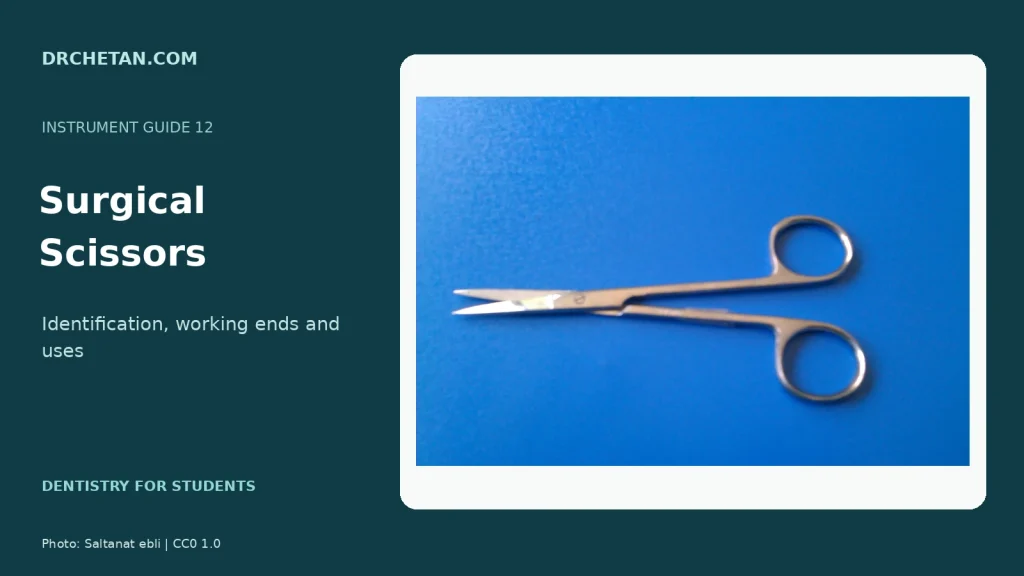
Surgical scissors are best identified by blade proportions, curvature and tip design. Learning these features is more reliable than trying to recognise an instrument from its finger rings alone.
A learning guide for dental students. Clinical use requires practical training and supervision.
Photographic reference
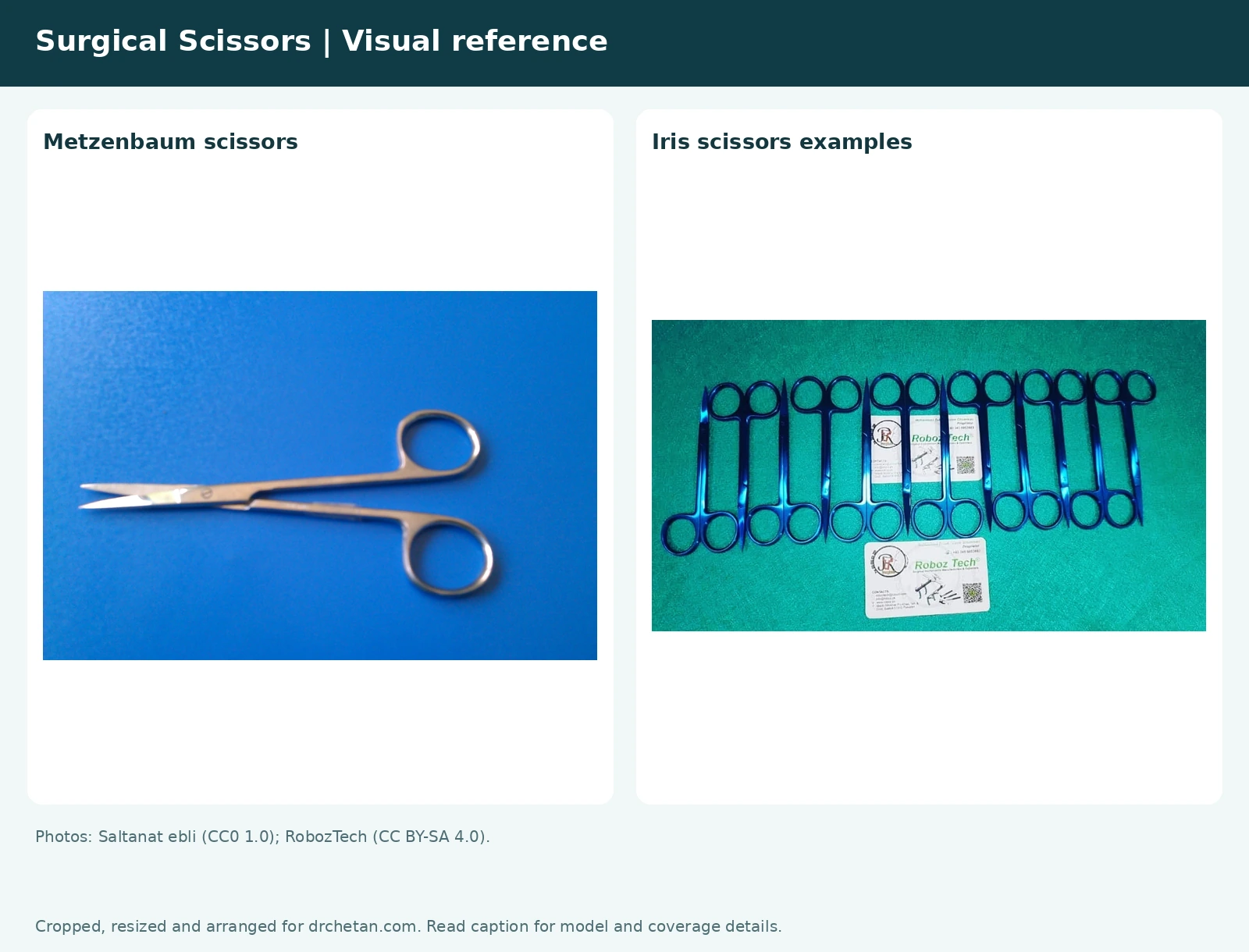
The four features to inspect first
- Blade shape: straight, curved or angled. Look from the side as well as from above.
- Tip configuration: sharp–sharp, blunt–blunt or sharp–blunt.
- Proportions: compare the blade length and thickness with the shanks and overall length.
- Cutting surface: smooth, serrated or a specialised edge; check the actual model.
Curved describes the blades, whereas blunt describes the tips. A pair can therefore be both curved and blunt–blunt. Do not treat these descriptions as competing classifications.
Common named patterns
| Pattern | Typical recognition points | Broad association |
|---|---|---|
| Iris | Small, fine scissors with short, delicate blades; straight and curved versions | Fine soft-tissue cutting when appropriate |
| Metzenbaum | Relatively long shanks compared with short blades; delicate construction | Soft-tissue cutting and dissection |
| Mayo | More robust blades and construction than fine dissecting scissors | Heavier tissue or material tasks, depending on the model |
| Goldman–Fox | Periodontal scissors; particular versions have a serrated blade | Controlled cutting of gingival tissue |
| LaGrange | Distinctive curved or angled periodontal pattern; confirm the catalogue view | Access to selected soft-tissue sites |
Named patterns have variations. Exact lengths, blade edges and tip combinations should be learnt from the instruments in your department and the matching manufacturer catalogue, rather than a single universal chart.
Iris versus Metzenbaum versus Mayo
An Iris scissors is often recognised as a small, fine instrument. Metzenbaum scissors usually make the long-shank/short-blade relationship more obvious. Mayo scissors are sturdier. These comparisons concern design, not a claim that a particular overall length always belongs to one family.
When instruments are closed, a fine scissors can resemble a haemostat. Scissors have opposing cutting blades that pass one another; a haemostat has gripping jaws that meet. Ordinary surgical scissors do not have the locking ratchet typical of artery forceps. A combination instrument, such as an Olsen–Hegar needle holder, is an exception that must be recognised separately.
Straight versus curved scissors
Straight blades make the direction of a cut relatively easy to visualise in a direct line. Curvature may assist access and visibility around tissue contours. Neither shape is automatically safer or more precise in every site: visibility of both the target and adjacent structures is essential.
Examine a curved instrument from more than one angle during a practical examination. A top-down photograph can hide curvature, and a closed blade profile can make a blunt tip look pointed. State what you can actually see before assigning a specific pattern.
Tissue scissors and suture-removal scissors
Tissue scissors are designed to cut suitable soft tissue. Suture-removal scissors may have a small notch or hook on one blade to help engage a suture. Not every scissors used to cut a suture is a dedicated suture-removal design, and the notch is not a feature of all surgical scissors.
Using fine tissue scissors for paper, packaging, thick material or wire can damage their cutting edges and alignment. Orthodontic wire requires the appropriate cutter; it should not be cut with ordinary surgical scissors. Follow the manufacturer’s intended use and the clinic’s instrument-separation policy.
Sharp and blunt tips: what the words mean
A blunt tip has a rounded end rather than a piercing point. It may reduce the chance of puncture during suitable manoeuvres, but the blades still cut and the instrument can still injure tissue. Sharp tips support fine access but require careful control. Neither tip type justifies cutting an unseen structure.
Do not confuse a blunt tip with a dull cutting edge. A properly maintained blunt-tipped scissors should still cut effectively. A worn or misaligned scissors can fold or tear material rather than making the intended clean cut.
Inspection and viva checklist
- Name the family and pattern if confirmed.
- Describe curvature, tips and blade-to-shank proportions.
- Give a broad intended task and one unsuitable use.
- Check for damaged tips, poor alignment, corrosion or an impaired joint according to the manufacturer’s instructions.
- Process reusable scissors according to the validated cleaning and sterilisation instructions; do not improvise a sharpening method.
Viva example: “This is a Metzenbaum scissors. Its relatively long shanks and short blades support identification. It is intended for appropriate soft-tissue cutting and dissection; it is not a wire cutter.”
Frequently asked questions
Are Iris scissors always straight?
No. Straight and curved Iris patterns are available.
What is the main visual clue for Metzenbaum scissors?
The relatively long shanks compared with the short cutting blades, together with the delicate construction. Confirm the pattern rather than relying on this clue alone.
Are blunt scissors supposed to be dull?
No. Blunt refers to the tip shape. The cutting edges still need to be serviceable.
Can surgical scissors cut orthodontic wire?
Ordinary surgical scissors should not be used as wire cutters. Use a cutter intended for that wire and task.
How do suture-removal scissors differ?
Some have a notch or hook to engage a suture. The exact design varies, so check the actual instrument.
References and further reading
Featured-image photograph: Saltanat ebli — source photograph (CC0 1.0). Resized and arranged with title. Adapted visual: CC BY-SA 4.0.
Explore more dental instrument guides and articles for dental students.

Leave a Reply