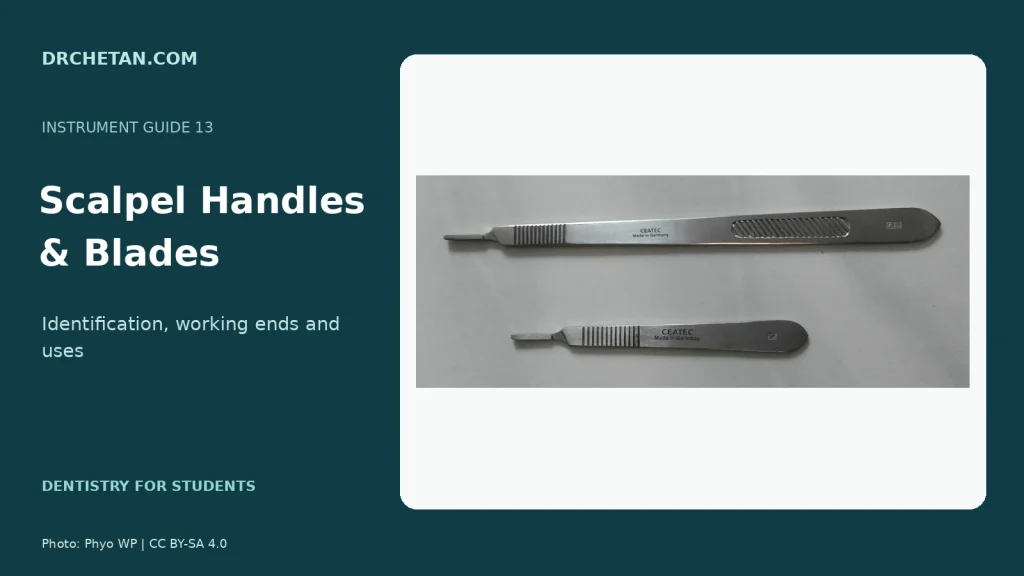
A scalpel is a cutting assembly: the handle provides control, while the blade provides the cutting edge. For identification, learn the blade outline and attachment system together rather than memorising the blade number alone.
A learning guide for dental students. Clinical use requires practical training and supervision.
Photographic reference
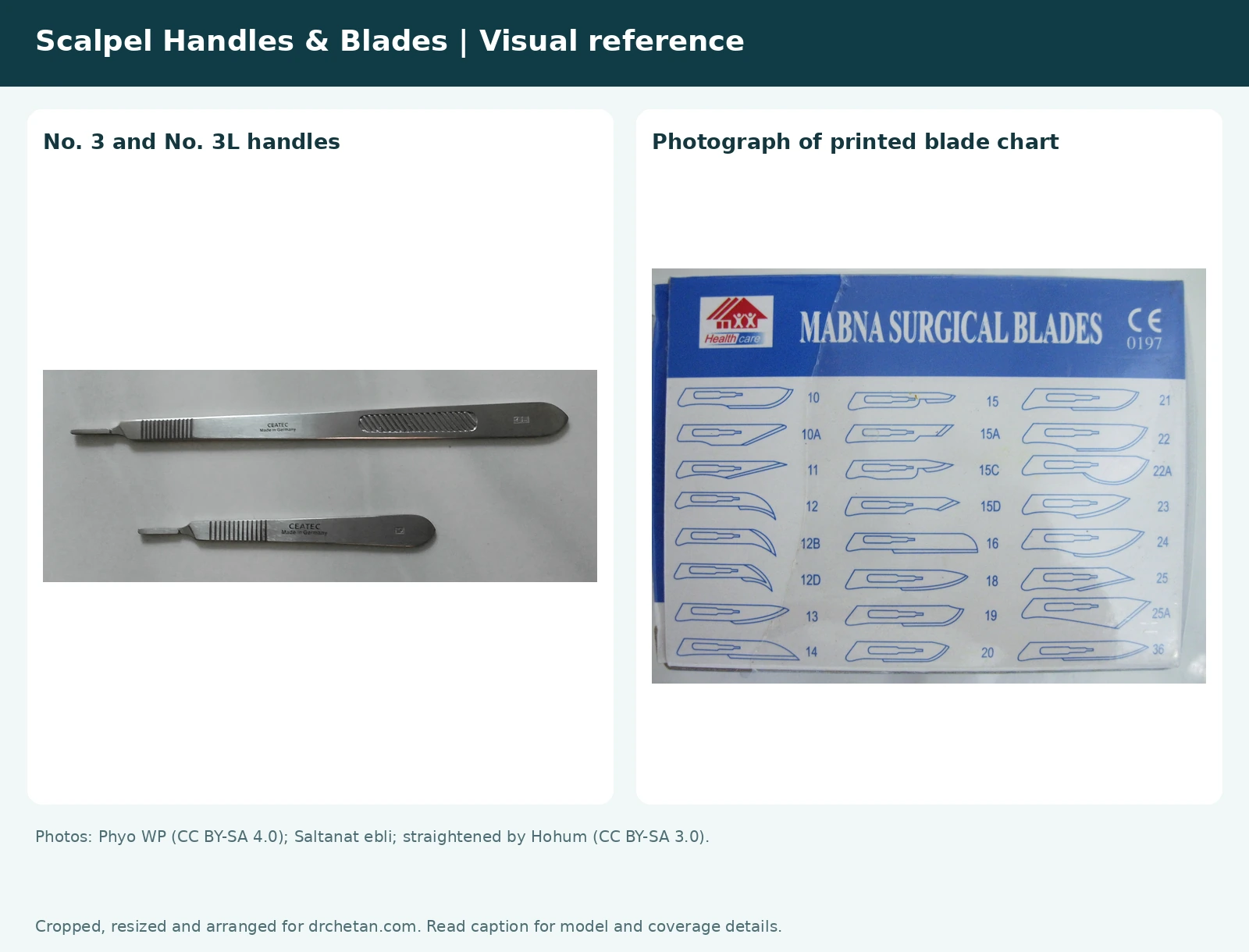
Parts of the scalpel assembly
A detachable scalpel has a reusable handle and a separate blade. The handle includes a grip and a blade-mounting end, often called the tang. The blade has an attachment slot, a heel near its base, a back or spine, a cutting edge and a point. Not every visible border is a cutting edge.
Disposable scalpels may have the blade supplied already attached to a single-use handle. Safety scalpels add a protective mechanism. These are design categories, not blade shapes: a familiar blade outline may be supplied in more than one assembly.
Common blade shapes
| Blade | Recognition point | Learning context |
|---|---|---|
| No. 10 | Broad curved cutting edge with a rounded belly | General comparison blade; larger curved profile than No. 15 |
| No. 11 | Elongated triangular, sharply pointed outline | Pointed entry blade; not a substitute for every flap-incision blade |
| No. 12 | Hooked or crescent outline; cutting edge on the inside of the curve | Selected curved-access surgical tasks |
| No. 15 | Small curved cutting edge | A commonly encountered blade for controlled short incisions in oral surgery |
| No. 15C | More slender profile with an extended cutting edge compared with No. 15 | Fine access, including periodontal applications |
A blade number is a design identifier, not its length in millimetres. Similar-looking variants such as 12D or 15C must not be assumed identical to 12 or 15. Use the packaging and manufacturer drawing to confirm the exact edge design.
Handles and compatibility
A standard No. 3 handle accepts the manufacturer’s small-fitment blades, including commonly encountered No. 10, 11, 12, 15 and 15C blades in the Swann–Morton range. The manufacturer’s compatibility list is the deciding reference. A No. 4 handle uses a different fitment family; it is not a universal replacement.
No. 3L is an elongated handle, while round or octagonal handles offer different grip forms. An extended or differently shaped handle does not by itself tell you which blade fits. Check the handle marking, the blade system and the current instructions before assembly.
“Bard–Parker” or “BP handle” is often used in teaching discussions of detachable scalpels. In a practical examination, give the actual handle number and compatible blade family when you can verify them.
No. 15 versus No. 15C
Both are small blades, but the No. 15C has an extended cutting edge and a slimmer profile. The manufacturer describes its added reach as useful for periodontal work. It is therefore inaccurate to call 15C merely a smaller No. 15 or assume the two have an identical edge.
Selection also depends on access, tissue, procedure, handle and the operator’s training. Recognition of the outline does not establish which blade should be used for an individual patient.
Safe handling and sharps disposal
An exposed blade is a sharp even before it is used. Fit and remove blades using the approved instrument or blade-removal device and the manufacturer’s method; do not grip the cutting blade with bare or gloved fingers. Use a designated sharps container and the clinic’s sharps-transfer procedure.
Single-use blades are not made reusable by wiping or sterilising them. A reusable handle must be cleaned and sterilised according to its own instructions. The blade and handle may therefore require different disposal and reprocessing routes.
If attachment is uncertain, the blade is damaged or the safety mechanism is faulty, stop and replace or check the component. Do not bend a blade to force an incompatible fit.
Common mistakes and viva practice
- Identifying the handle as a No. 3 solely because a small blade is nearby.
- Calling every curved blade a No. 15 without examining its profile.
- Confusing the printed blade number with the blade’s length.
- Assuming all scalpel handles accept all blades.
- Treating a safety cover as permission to bypass sharps precautions.
Viva example: “This is a No. 3 scalpel handle. In the specified manufacturer’s system it takes the small-fitment blade family. A No. 15 has a short curved cutting edge, while a No. 11 is triangular and pointed.”
Frequently asked questions
Which blades fit a No. 3 scalpel handle?
Common examples in the Swann–Morton system include 10, 11, 12, 15 and 15C. Confirm the complete manufacturer-specific compatibility list.
Is blade No. 15 fifteen millimetres long?
No. The number identifies the blade design; it is not a millimetre measurement.
How is 15C different from 15?
It has a more slender profile and an extended cutting edge, which can aid fine access.
Does a No. 4 handle fit the same blades as No. 3?
No. They belong to different fitment families. Never force a blade onto a handle.
Can a disposable scalpel blade be sterilised for reuse?
A blade labelled single use should be discarded through the appropriate sharps route after use, rather than reprocessed.
References and further reading
- Swann–Morton: No. 3 handle and compatible blades
- Swann–Morton: No. 15C blade
- Swann–Morton: No. 15 blade
Featured-image photograph: Phyo WP — source photograph (CC BY-SA 4.0). Resized and arranged with title. Adapted visual: CC BY-SA 4.0.
Explore more dental instrument guides and articles for dental students.

Leave a Reply