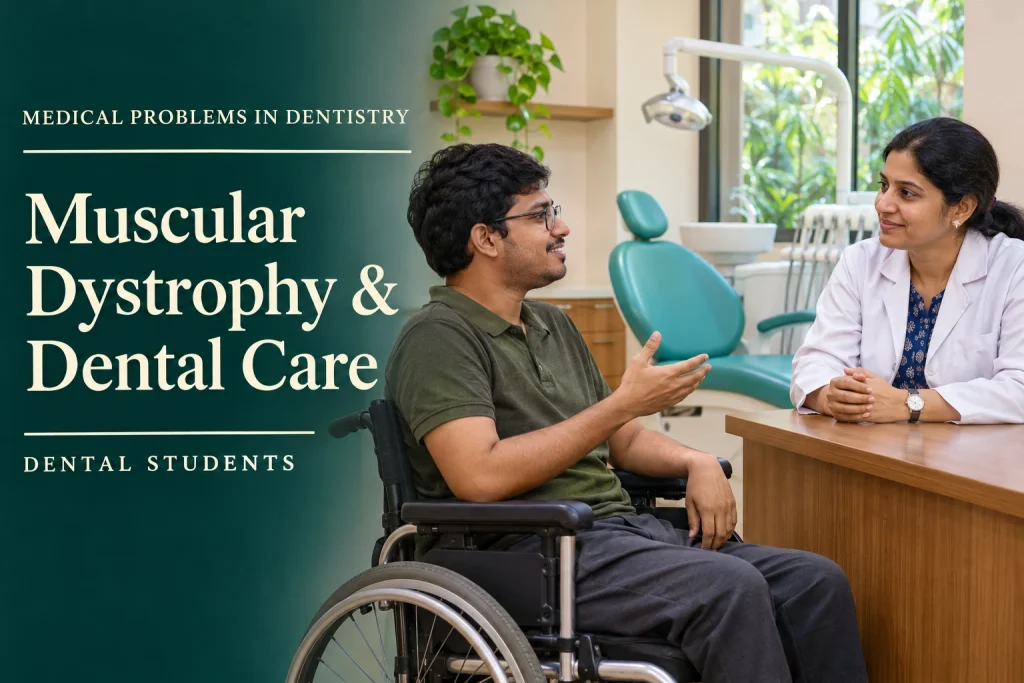
Medical Problems in Dentistry: Article 104 of 215 · Muscle disorders · Complete student guide
Medical Problems in Dentistry · Student guide
Muscular dystrophy describes a group of genetic muscle disorders, not a single dental risk category. People differ in muscle involvement, cardiac and respiratory function, swallowing, mobility and support needs. The diagnosis should prompt a focused conversation and appropriate adaptations while preserving the person’s involvement in decisions.
In this guide: Learning objectives · Start with this clinical case · Establish subtype and current medical care · Plan access and positioning without assumptions · Assess the demands of the actual dental procedure · Use a functional planning table · Recognise the Duchenne/Becker anaesthetic distinction · Build prevention and a clear handover · Viva and self-check
Learning objectives
- Confirm subtype and current function rather than infer risk from mobility alone.
- Plan access, positioning and prevention around the person’s needs.
- Distinguish Duchenne/Becker anaesthetic concerns from malignant hyperthermia susceptibility.
Start with this clinical case
Fictional teaching case. An adult wheelchair user with Duchenne muscular dystrophy needs restorative care. They use respiratory support at home and have a cardiology follow-up plan. They prefer to remain in their own chair for the consultation. The student must establish what treatment the setting can safely provide, not assume that every visit requires general anaesthesia.
Establish subtype and current medical care
Confirm the exact diagnosis, neuromuscular service, current treatment and recent changes. Ask about heart disease, breathing support, respiratory infections, cough effectiveness, swallowing and previous anaesthesia. NINDS describes substantial variation among muscular dystrophies, including possible heart, respiratory and swallowing involvement.[MD]
Record what the patient can comfortably do now and any relevant specialist instructions. Walking ability or use of a wheelchair does not supply a complete cardiopulmonary assessment. Ask the person how they communicate, what assistance they want and whether a supporter should join the discussion.
Plan access and positioning without assumptions
Check the route, doorway, waiting area and treatment space before the appointment. Ask about usual transfers and supports. Remaining in an appropriate wheelchair for some assessments may be preferable, while other procedures may require different equipment or a specialist service. Confirm safety and access rather than improvise a lifting technique.
Use comfortable positioning, explain movements and avoid force. Agree on breaks and a stop signal. Consider how the person will manage the return journey and usual care after treatment. An appointment plan should include these practical steps, not just the operative task.
Assess the demands of the actual dental procedure
Determine likely duration, mouth-opening requirements, fluid/debris management, effect on eating and need for pain control. Assess local dental disease independently and discuss whether staged treatment is reasonable. An active infection requires timely assessment and an appropriate plan.
PPMD’s dental guidance emphasises preventive care and appropriate anaesthesia planning. People with pulmonary dysfunction needing general anaesthesia require a suitably equipped setting and an anaesthetist able to manage cardiac and respiratory complications. A familiar drug or a normal single observation does not replace an individualized assessment.[PPMDDENT]
Use a functional planning table
| Finding or question | Clinical implication | Student action |
|---|---|---|
| Respiratory support or weak cough | Airway clearance and treatment endurance may matter | Clarify current respiratory status and the required care setting. |
| Cardiomyopathy or cardiac follow-up | Procedure and medicine planning may change | Ask a specific cardiology/anaesthesia question when indicated. |
| Difficult transfers or painful positioning | The standard chair arrangement may be unsuitable | Arrange trained assistance and appropriate equipment beforehand. |
| Difficulty with daily brushing | Prevention must fit available function | Agree on suitable aids or chosen assistance and review the result. |
Recognise the Duchenne/Becker anaesthetic distinction
PPMD identifies serious anaesthetic risks in Duchenne/Becker, including dangerous hyperkalaemia with succinylcholine and anaesthesia-associated rhabdomyolysis with certain agents. These complications are not the same as inherited malignant hyperthermia susceptibility. Do not label every person with a dystrophy “MH susceptible” or apply one subtype’s advice to all muscle disorders.[PPMD]
Local anaesthesia and general anaesthesia are different interventions. The anaesthesia team must consider the individual’s cardiac/respiratory status and exact diagnosis even where an agent is not an MH trigger. Do not independently stop long-term glucocorticoids or introduce sedative medication without a coordinated plan.
Build prevention and a clear handover
Ask which cleaning steps are difficult because of grip, fatigue, limited opening or assistance needs. Demonstrate achievable options and obtain the patient’s agreement about any support. Address caries, periodontal disease and prosthesis problems early to reduce future treatment burden.
For the case, begin with the patient’s preferred accessible consultation, define the restorative task and obtain relevant respiratory/cardiac information. If a higher-support setting is needed, provide a focused referral naming the dental urgency and proposed intervention. Record who coordinates each part of care and how new swallowing or breathing symptoms should be assessed.
Viva and self-check
Does a wheelchair identify the person’s respiratory risk? No. Current subtype-specific medical and functional information is required.
Are Duchenne anaesthesia-associated rhabdomyolysis and MH identical? No. They are distinct problems with different underlying mechanisms.
Does muscular dystrophy mean all dentistry requires general anaesthesia? No. The person, procedure and available support determine the plan.
Continue through the series
- Previous: Myasthenia Gravis: Dental Fatigue, Swallowing and Prescribing Precautions
- Next: Inflammatory Myopathy: Oral Function and Immunosuppressive Therapy
- Browse all 215 student guides by subject
More in Muscle disorders: Myasthenia Gravis: Dental Fatigue, Swallowing and Prescribing Precautions · Inflammatory Myopathy: Oral Function and Immunosuppressive Therapy · Malignant Hyperthermia Susceptibility: Dental Anaesthesia History and Referral · Muscle Weakness, Dysphagia and Breathlessness: Recognising a Patient Who Needs Medical Assessment
Continue learning
- Structured medical history and examination
- Medical liaison and referral for complex dental patients
- Informed consent in an Indian dental practice
References and scope
Sources checked on 26 November 2026. This is an original student teaching guide. International clinical recommendations are identified by their issuing organisation. Emergency contact information is specific to India. Use current local protocols, appropriate supervision and an individual clinical assessment.
- NINDS: Muscular Dystrophy
- Parent Project Muscular Dystrophy: Dental Procedures
- Parent Project Muscular Dystrophy: Surgery and Anaesthesia Precautions
Images are AI-generated educational illustrations of fictional people or equipment, not clinical records or diagnostic photographs.

Leave a Reply