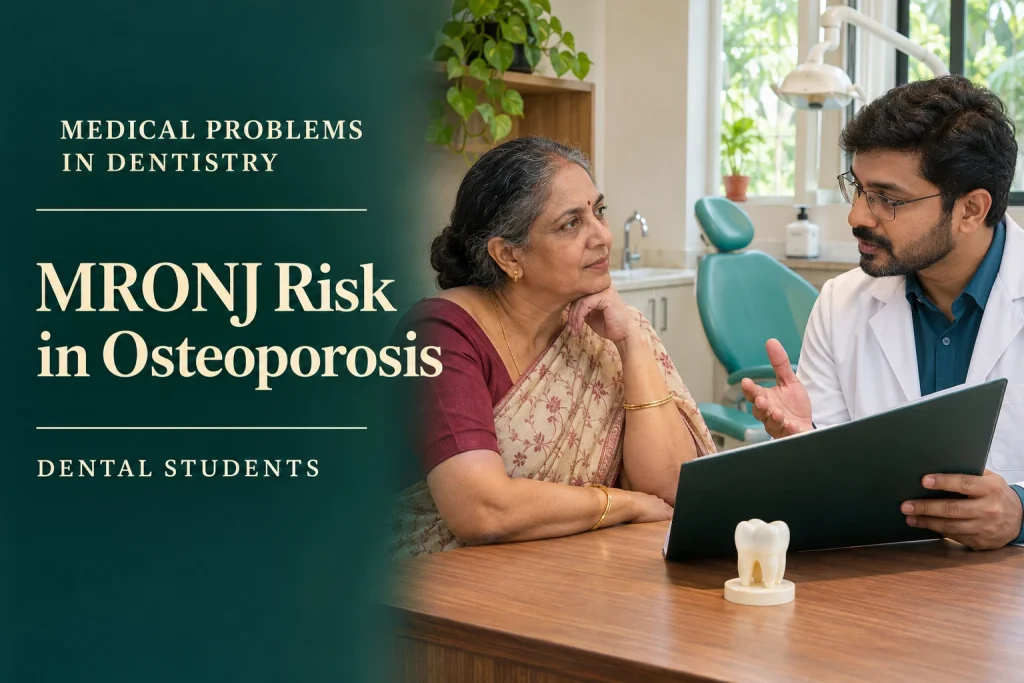
Medical Problems in Dentistry: Article 100 of 215 · Bone disorders · Complete student guide
Medical Problems in Dentistry · Student guide
This guide focuses on the dental risk consultation and follow-up for medication-related osteonecrosis of the jaw (MRONJ). The key questions are what the patient has received, what the tooth and surrounding tissues need, and whether a healing problem already requires assessment. A medicine name alone does not decide the treatment.
In this guide: Learning objectives · Start with this clinical case · Establish whether there is an existing problem · Reconstruct the exposure accurately · Make the dental diagnosis independently · Organise the risk consultation · Explain what a holiday or CTX result cannot prove · Document consent and review healing · Viva and self-check
Learning objectives
- Use the AAOMS case definition without delaying assessment of earlier symptoms.
- Build a procedure-specific risk discussion from actual exposure and oral findings.
- Explain the limits of drug holidays and biochemical clearance tests.
Start with this clinical case
Fictional teaching case. A patient taking an osteoporosis antiresorptive needs a molar extraction. They ask for a CTX blood test and say they will stop their medicine until the number is “safe”. At examination, a separate denture-trauma site is sore. These concerns need an individual assessment rather than a laboratory pass/fail rule.
Establish whether there is an existing problem
Ask about exposed bone, persistent pain, swelling, discharge, altered sensation, previous non-healing extraction sites and denture trauma. Examine the symptomatic area and the tooth requiring treatment. Record the duration and findings and retain alternatives such as dental infection, local trauma and other jaw pathology.
The AAOMS 2022 case definition combines relevant current or previous drug exposure, exposed bone or bone probeable through a fistula persisting beyond eight weeks, and no history of jaw radiation or jaw metastasis. This definition is not an instruction to wait eight weeks before investigating a painful or non-healing site. Imaging and specialist assessment may be needed when the findings are uncertain.[AAOMS]
Reconstruct the exposure accurately
Confirm the drug, indication, route, frequency, start date, previous treatments and last administration. Ask specifically whether a similar medicine was given for cancer rather than osteoporosis. Review relevant comorbidities and concurrent treatment, including glucocorticoids and other therapies that may affect infection or healing.
Use a prescription record or the treating service when the patient cannot name the medicine. Record uncertainty explicitly. A previous course remains relevant even if the patient says they are “not taking anything now”. Do not assign an individual risk percentage from the route alone.
Make the dental diagnosis independently
Assess restorability, infection, periodontal support, symptoms and reasonable alternatives. Consider whether tooth-preserving treatment is appropriate, while avoiding retention of hopeless infected teeth merely because surgery sounds worrying. Explain why the chosen approach addresses the actual dental disease.
ADA guidance emphasises prevention and prompt management of active oral disease. Routine treatment is not automatically changed solely because osteoporosis antiresorptive exposure is present. The risk discussion should include the consequences of leaving disease untreated as well as the proposed procedure’s risks.[ADABONE]
Organise the risk consultation
| Finding or question | Clinical implication | Student action |
|---|---|---|
| Exact drug and indication unknown | Exposure cannot yet be interpreted properly | Obtain a reliable medicine history before a non-urgent invasive decision. |
| Painful or non-healing site already present | A current disease problem may need assessment | Document, investigate and refer as appropriate without waiting for a duration threshold. |
| Restorable tooth versus hopeless infected tooth | The treatment alternatives differ | Compare clinically appropriate options and explain the reason for the recommendation. |
| Patient proposes stopping denosumab | Systemic fracture protection may be affected | Coordinate any change with the prescribing team. |
Explain what a holiday or CTX result cannot prove
ADA finds insufficient evidence to recommend a routine antiresorptive holiday solely to prevent osteoporosis-related MRONJ and does not endorse CTX for predicting an individual’s MRONJ risk. A particular result cannot guarantee uncomplicated healing. Stopping a bisphosphonate also does not erase prior exposure.[ADABONE]
Denosumab requires a separate medical plan if interrupted. Endocrine Society guidance for postmenopausal osteoporosis cautions against delaying or stopping it without suitable subsequent treatment because bone loss and fracture risk can increase. Do not replace that medical decision with a dental “stop until healed” instruction. The patient, dentist and prescriber should understand who is responsible for any agreed change.[ENDO]
Document consent and review healing
Record the dental diagnosis, drug history, options, relevant advice and the patient’s questions. Agree on the care setting, review arrangements and how to seek help for increasing pain, swelling, bone exposure or persistent non-healing. Specialist management is individualized; a student risk table is not a surgical or antibiotic protocol.
For the case, verify the antiresorptive regimen, assess the molar and denture sore separately, and explain why CTX does not provide clearance. Treat denture trauma and arrange any necessary assessment of the site. Maintain prevention and follow-up rather than promising that a medicine holiday removes all risk.
Viva and self-check
Does the eight-week case-definition criterion mean symptoms should be ignored until then? No. Assess concerning symptoms or poor healing promptly.
Can CTX provide a guaranteed safe extraction threshold? No. It is not a validated individual MRONJ clearance test.
Who should coordinate any denosumab interruption? The prescribing medical team with the dental clinician and patient, considering fracture protection as well as the procedure.
Continue through the series
- Previous: Osteoporosis and Dental Care: Fracture Prevention, Antiresorptives and Oral Risk
- Next: Paget Disease and Fibrous Dysplasia: Jaw Findings and Dental Implications
- Browse all 215 student guides by subject
More in Bone disorders: Osteoporosis and Dental Care: Fracture Prevention, Antiresorptives and Oral Risk · Paget Disease and Fibrous Dysplasia: Jaw Findings and Dental Implications · Osteomalacia, Rickets and Osteogenesis Imperfecta: Dental Features and Care Planning
Continue learning
- Medical liaison and referral for complex dental patients
- Structured medical history and examination
- Informed consent in an Indian dental practice
References and scope
Sources checked on 26 November 2026. This is an original student teaching guide. International clinical recommendations are identified by their issuing organisation. Emergency contact information is specific to India. Use current local protocols, appropriate supervision and an individual clinical assessment.
- AAOMS Position Paper on Medication-Related Osteonecrosis of the Jaw—2022 Update
- ADA: Osteoporosis Medications and MRONJ
- Endocrine Society: Pharmacological Management of Osteoporosis in Postmenopausal Women
Images are AI-generated educational illustrations of fictional people or equipment, not clinical records or diagnostic photographs.

Leave a Reply