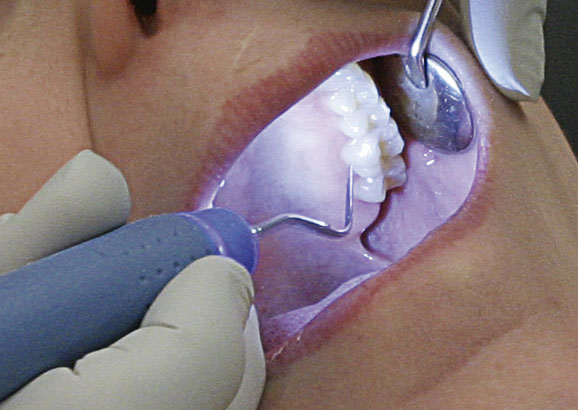
 It is common for people to get anxious when they have to visit a dentist. For many people they find it torturous when it comes to getting their teeth cleaned. People immediately want to leave the dentist chair that moment their mouth has been pricked a couple of times with a scaler since it is such as sensitive area. To provide patients a more thorough dental cleaning in comparison to manual teeth cleaning by hand, a latest and painless method has emerged by the name of Ultrasonic dental cleaning.
The History of Ultrasonic Teeth Cleaning
People might have heard about it more recently but the invention of Ultrasonic cleaning is not really new. The ultrasonic cleaning method was initially in fact used for the cleaning of aircraft parts when it was first created in the 1950s. It took a look type of this method to become available for dental use. Patients are now able to have their teeth cleaned with lower costs due to the use of this method in dental procedures.
How Ultrasonic Teeth Cleaning Works
The scaler used in this method has a rather thin tip. The scaler is then held against every tooth where it produces sound waves. Tarter and plaque is broken up once these waves bounce off the tooth. Even the really hardened plaque which is known as calculus is easily broken up since these sounds waves work really well. All the broken debris is washed away from the water that comes out from the scaler. Traditional hand scaling methods often damage the tooth’s enamel but the tip of the scaler used in this method does not do that. The best part is that patients get to experience a painless process since only the vibrations from the scaler are used which are harmless.
Benefits of Ultrasonic Dental Cleaning
By requesting an ultrasonic dental cleaning you can avail a lot of benefits. Unlike traditional hand scaling this method is much quicker. Hand scaling cannot reach below the gum line where the plaque and tartar is found but the small tips used in the ultrasonic method can easily remove them. Dental diseases such as periodontal disease and gingivitis can also be prevented with the use of this dental cleaning method. Heavy stains on your teeth from coffee, nicotine and tea can also be easily removed with this method.
Conclusion
There are tremendous benefits if you go through the ultrasonic teeth cleaning procedure. You can now take control over any potential dental diseases and prevent them without experiencing any pain.
There are quite a few advantages and disadvantages of both the hand scaling and the ultrasonic scaling, so they cannot be preferred one over the other at certain cases. Sensitive teeth cannot bear the pressure at which the water jet is sent from the ultrasonic scaler, but on the same time, the dark and hard stains cannot be removed using the hand scaling techniques.

These tips are very knowledgeable. This information is very magnetic. It is very difficult to found this type of blog. Thanks
Nice article,please let me download this article
I would like to know what really removes the build-up from the teeth. I get the feeling that “ultrasonic” is more of a description of the working frequency than a term describing a sonic action.
It seems that sound (sonic) waves conducted through an air gap would not have the energy to break apart hardened material. Sound waves conducted through water (coupled in water) would have far more energy delivered and possibly break apart matter. Still more, direct contact of the vibrating end effect or stylus would deliver much, much more energy. However, if the method of energy transport is direct contact then the actual method is mechanical inductance taking place at frequencies above the typical range of hearing (ultrasonic frequencies). Which of these is the principal transport mechanism of energy?