A nerve can carry information over a long distance because a change in voltage at one point triggers a fresh change nearby. The voltage difference across the resting membrane sets the conditions for that process. Local anesthetics reduce the ability of the membrane to generate the inward sodium current that sustains it. [1, 2, 3]
The resting membrane is electrically polarized
The inside of a resting axon is electrically negative relative to the outside. Ion concentrations differ across the membrane, and the membrane is more permeable to some ions than to others. Resting permeability to potassium is especially important in many neurons. Transport proteins, including the sodium-potassium pump, maintain the underlying gradients over time. The pump does not generate the rapid rise and fall of each spike. [1]
Think of the voltage as a difference between two sides of a very thin membrane. It is not a measure of how much total sodium or potassium the whole cell contains. Moving a small fraction of ions through membrane channels can change the local voltage substantially.
What happens when threshold is reached
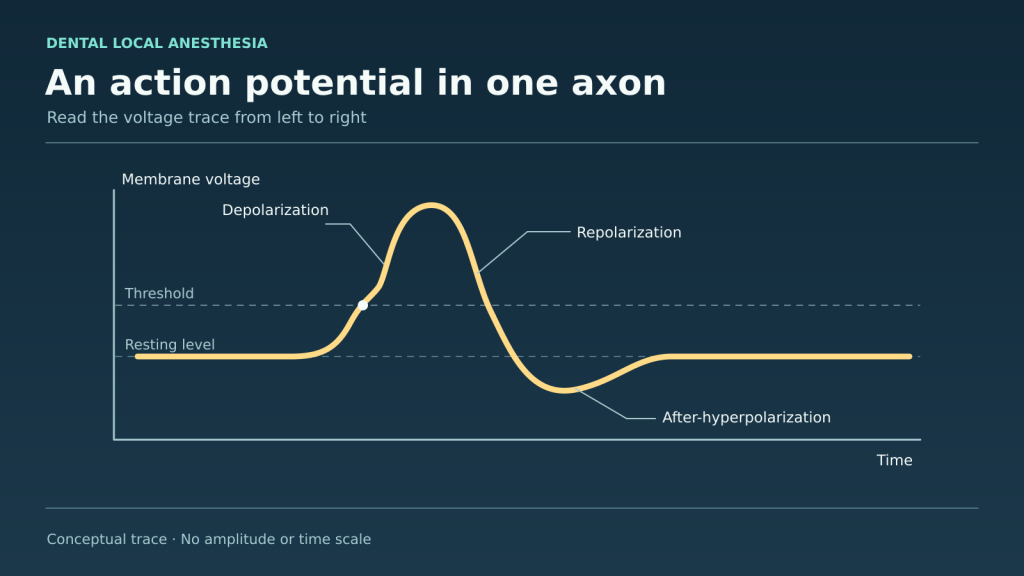
A small local depolarization can spread passively and fade. When depolarization recruits sufficient voltage-gated sodium channels, inward sodium current causes further depolarization. The positive feedback produces the rapid rising phase. The probability of channel opening depends on voltage and on the channel’s preceding state. [1, 2]
| Phase | Main change in the simplified model |
|---|---|
| Rest | Many sodium channels are closed but available to activate. |
| Rising phase | Sodium conductance rises rapidly and inward current depolarizes the membrane. |
| Falling phase | Sodium channel inactivation and increasing potassium conductance help repolarize the membrane. |
| Recovery | Channels recover from inactivation and excitability returns toward its resting state. |
During the absolute refractory period, the membrane cannot generate another normal spike because too few sodium channels are available. In the relative refractory period, a stronger stimulus may be needed. These periods limit firing frequency and help explain why the region behind a traveling spike usually does not immediately fire again. [1, 2]
How a spike propagates
The active segment sends local current into adjacent membrane. When that adjacent region reaches threshold, it generates its own action potential. A propagating spike therefore does not fade the way a purely passive voltage change does. In myelinated fibers, myelin reduces current leakage between nodes, and impulses are regenerated at successive nodes. Unmyelinated fibers regenerate the impulse along the excitable membrane. [1, 4]
An individual spike is often described as all-or-none under given conditions. A stronger stimulus can still produce a stronger sensory response because fibers may fire more frequently or additional fibers may be recruited. A more intense feeling does not require each axon to generate a proportionally larger spike.
Where local anesthesia interrupts the sequence
Voltage-gated sodium channels are required to sustain the inward current. If a local anesthetic reduces available sodium conductance sufficiently in a region, the signal loses its ability to regenerate beyond that region. The sensory ending may still respond to a stimulus upstream. The resulting impulses fail to propagate through the adequately blocked segment. [3, 2]
The effect is local and reversible as drug concentration falls. This distinction matters when reading a diagram. Show an impulse approaching the exposed segment and failure of regeneration there. Do not draw a severed axon or depict a local anesthetic as permanently eliminating conduction.
Summary
Ion gradients and permeability establish resting voltage. Sodium activation provides the rapid depolarizing current, and sodium inactivation with potassium conductance helps end the spike. Propagation depends on repeating that process along excitable membrane.
References
- Long-Distance Signaling by Means of Action Potentials – Neuroscience
- Voltage-Gated Na+ Channels – Jasper’s Basic Mechanisms of the Epilepsies
- Local anesthetics: hydrophilic and hydrophobic pathways for the drug-receptor reaction
- Increased Conduction Velocity as a Result of Myelination – Neuroscience

Leave a Reply