Your teeth can look clean while a thin film of plaque remains near the gums or between the teeth. A plaque disclosing tablet or solution uses dye to make that film easier to see. It can help you discover the places your usual cleaning routine misses. [1]
The dye is a learning aid. It does not remove plaque, dissolve tartar or diagnose an infection.
What does a plaque disclosing product do?
Plaque is a bacterial film that accumulates on teeth. Because it can be hard to see, disclosing dye makes a useful visual check. After using the product as directed, you examine the coloured areas in a mirror and improve your cleaning there. [1,2]
Think of the colour as feedback about where to pay attention. A coloured patch is not proof of a cavity or a particular gum disease. Equally, a mouth with little visible colour is not a substitute for a dental examination.
Tablets, liquids and two-tone products
Tablets are typically chewed and spread around the teeth with saliva. Liquids or swabs are applied according to their own instructions. These formats are not necessarily interchangeable, so check the label rather than copying the quantity or contact time for another product. [2,3]
Some products use one colour. Others use two colours to distinguish plaque with different characteristics. For example, a particular product may describe red as newer plaque and blue as older plaque. The colour key is product-specific: it does not precisely date every deposit or tell you how severe a disease is. [4]
Before you use one
- Read the age restrictions, ingredients and warnings on the package.
- Only use a product that you can safely handle and spit out. A chewable tablet may be unsuitable for someone with swallowing difficulties or a choking risk.
- Supervise children and follow both the product’s age guidance and your dental team’s advice. Do not give a tablet to a young child who cannot reliably spit and follow directions.
- Check ingredients if you have known dye or flavouring allergies.
- Protect clothes and surfaces. Temporary staining of the tongue, lips and gums can happen; some orthodontic materials can also pick up colour. Ask your orthodontist if you are unsure about your appliance. [3,4]
Choose a time when temporary colour will not bother you. Use a product made for oral plaque disclosure, rather than household dyes or a homemade mixture.
How to use plaque disclosing tablets or solution
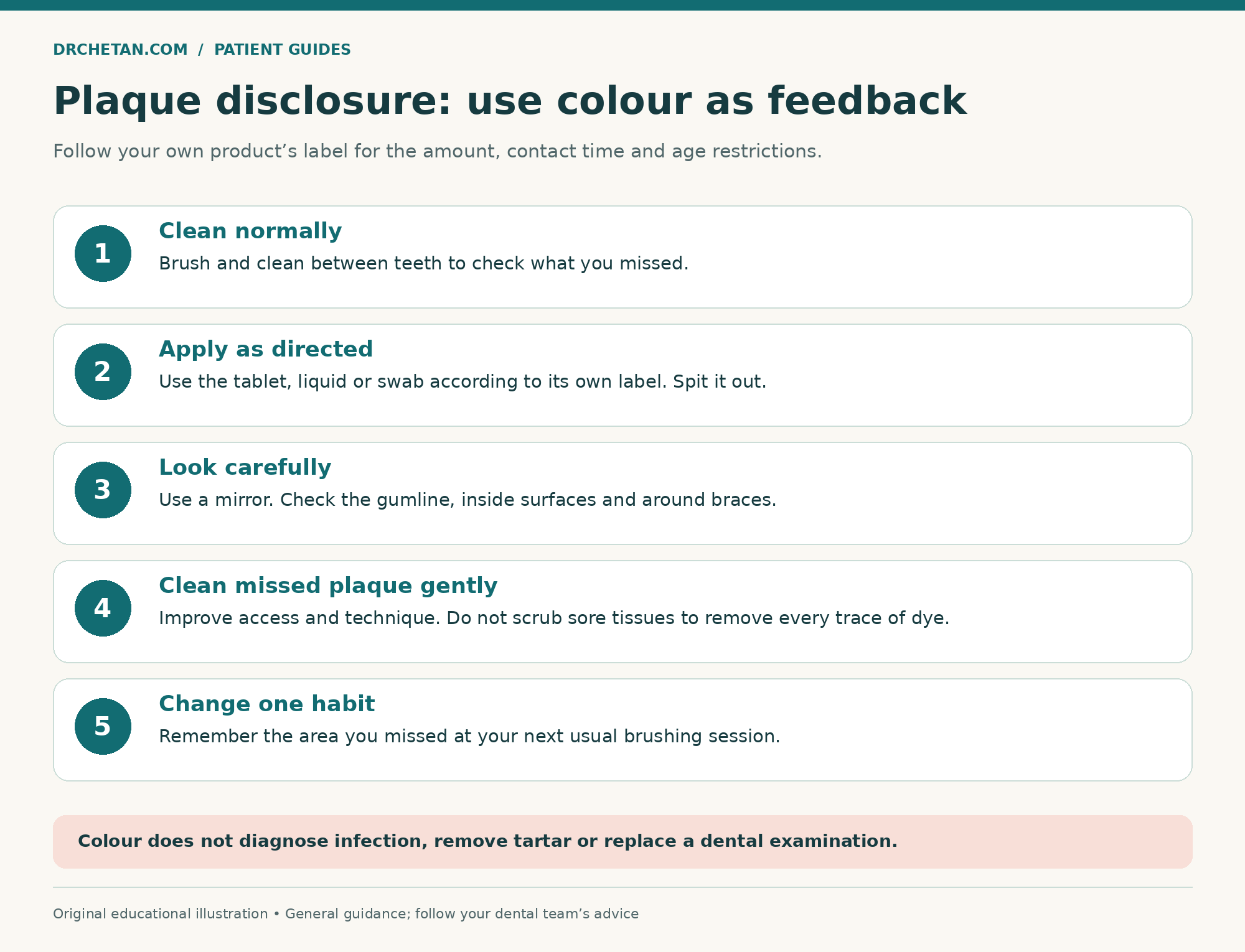
1. Start with your usual cleaning
If you are checking what you missed, brush and clean between your teeth first. A dentist may use disclosure before cleaning for a different teaching purpose; follow their instructions if they have given you a specific routine. [1,3]
2. Apply the product exactly as directed
For a tablet, this usually involves chewing and spreading the colour around the teeth without swallowing it. A liquid may have different application instructions. Follow the stated amount and contact time. There is no single “one-minute rule” for every brand. [2,3]
3. Spit out and inspect
Spit out the product, and rinse if its instructions require it. In a well-lit mirror, check the gumline, spaces between teeth, inside surfaces and back teeth. If you wear braces, look around the brackets and near the gums as well. A small dental mirror may help with difficult-to-see areas. [3]
4. Remove the highlighted plaque gently
Use your normal toothbrush to clean the missed areas and an appropriate interdental aid where needed. Focus on careful positioning rather than pressure. Do not keep scrubbing sore gums or your tongue to chase every trace of dye. Temporary staining of soft tissues is different from plaque remaining on a tooth. [1,3,4]
5. Use the result to change one habit
For example: “I keep missing the inside of my lower front teeth.” At the next normal brushing session, deliberately include that area. You do not need to turn every evening into a long cleaning test.
How often should I use disclosing tablets?
There is no need to assume that everyone must use them daily. Ask your dentist or hygienist whether occasional checks would help you, particularly while learning a new technique or cleaning around braces. Follow any frequency advice on the product label. [3]
Keep the usual foundation of your routine: brushing with fluoride toothpaste and daily cleaning between teeth. Disclosure adds feedback; it does not replace either habit. After your usual fluoride brushing, spit out excess toothpaste rather than rinsing immediately. If a disclosure session requires rinsing, keep that separate from the finish of your normal brushing routine where practical. [5]
What if the colour will not come off?
A persistent coloured area may need better brush positioning or help reaching between the teeth. It may also be staining rather than soft plaque. Hard tartar cannot simply be brushed away at home. If a deposit persists, ask your dental team to identify it rather than scraping it with a sharp object.
Arrange a dental assessment for bleeding or painful gums, swelling, or a tooth that hurts. A dye result cannot explain these symptoms.
Frequently asked questions
Will disclosing tablets whiten my teeth?
They are designed to show plaque, not bleach teeth or remove all types of stain.
Can I use them with braces?
They can help show missed plaque around appliances, but check with your orthodontist because some materials may stain. The colour does not mean a bracket or wire is damaged. [4]
Should I swallow the dye?
No. Spit it out as directed. If someone swallows more than the intended incidental amount, feels unwell, or you are unsure about the product, seek advice from a pharmacist, clinician or local poison-information service with the packaging available. Do not assume every disclosing formula has the same ingredients.
Do I still need a check-up if no plaque is visible?
Yes. Disclosure is a home cleaning check, not a test for every dental problem. Keep the review schedule recommended for your oral health.
Sources and further reading
- NIDCR: Oral hygiene
- Leeds Teaching Hospitals: How to use your disclosing tablets — example instructions for the product used by that service; your label may differ.
- MyHealth Alberta: Self-examination for dental plaque
- TePe: PlaqSearch patient leaflet — product-specific information, not a brand recommendation.
- NHS: How to keep your teeth clean

Hi Chetan, I have to say, what an impressive blog!! You work very hard at this. I teac h students in england how to become a dentist and am a dentist myself. I just wanted to sat good luck and well done
Alka
done a nice thing.. good luck..
thanks for the advice and information. i’ll try to buy plaque disclosing solution in the market. if ever kindly recommend one.
thanks again and GOD less.
i am,
amj
goodafternoon , i am studying to be a dental hygiene & have to give a presentation on plaque disclosing solution , i am not familiar with disclosing solutions , do have any tips for me ?, i would appreciate it , thank you .
hello………sir can u please send me the composition of two tone dyes
nice topic good luck