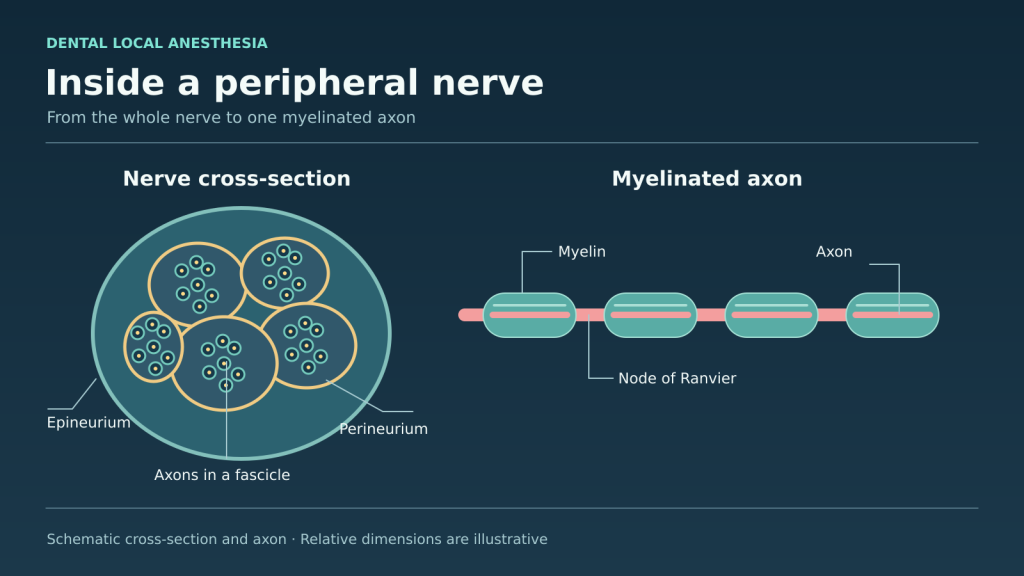
A peripheral nerve contains many axons arranged in bundles. A local anesthetic deposited near that nerve must travel through tissue and reach enough excitable membrane to change conduction. The path from the injection site to the axons helps explain why the effect is neither instantaneous nor identical across tissues. [1, 2]
Build the nerve from the inside out
An axon is a neuronal process that carries electrical impulses. In a myelinated peripheral fiber, Schwann cells wrap segments of axon in myelin. Adjacent segments are separated by short exposed regions called nodes of Ranvier. These nodes are important sites of action-potential regeneration. Unmyelinated fibers also associate with Schwann cells. Several small axons may be housed within one Schwann cell without the multilayer myelin wrapping of a myelinated fiber. [3, 4]
A nerve cross-section has three connective-tissue levels.
| Structure | Where it sits | Why it matters here |
|---|---|---|
| Endoneurium | Fine supporting tissue around individual nerve fibers within a fascicle | Provides the local environment around fibers and small vessels. |
| Perineurium | Layer surrounding each fascicle | Helps regulate entry into the fascicle and contributes to its barrier properties. |
| Epineurium | Outer connective tissue and tissue between fascicles | Provides support for the nerve as a whole and carries vessels within the nerve’s connective tissue. |
A fascicle is a bundle of nerve fibers enclosed by perineurium. [5] The boundaries above are distinct from the axon membrane, where voltage-gated sodium channels sit, and from the Schwann cell membrane that forms myelin. A drug can travel through several different environments before reaching its channel-binding site.
How insulation changes the signal
In a myelinated fiber, depolarizing current spreads rapidly along insulated portions of the axon. The action potential is regenerated at nodes, which produces saltatory conduction. Unmyelinated axons conduct through successive adjacent regions of excitable membrane. Diameter, myelin and channel distribution influence the speed and pattern of conduction. A schematic that shows a signal simply leaping over inactive space can obscure the local spread of current that links one node to the next. [3, 4]
Connect anatomy to injection design
Infiltration near the target tooth exposes terminal branches or small nerve territories after diffusion through local tissue. A regional block aims to interrupt conduction along a nerve supplying a larger field. The anatomy determines the intended target. Depot distance, tissue planes, barriers, perfusion and concentration over time affect how much drug actually reaches the axons. [1, 6]
More pressure or an assumed deeper placement is not a substitute for a correct target. An injection near a nerve is planned using recognized landmarks and technique safety checks. The details differ by block and require supervised training. A patient may notice a change in a superficial territory before the tissue you intend to treat is sufficiently anesthetized. Record what has changed and confirm the intended endpoint. [7]
Relate anatomy to incomplete coverage
If the gingiva in one area is numb while a nearby region remains sensitive, two explanations are worth keeping separate. The drug may not have reached sufficient concentration around all relevant fibers. Or the sensitive region may be supplied by a different nerve that was not part of the planned field. Both are plausible, and only the distribution, technique and clinical testing help distinguish them. This distinction is particularly useful for the mandibular molar buccal soft tissues, where the long buccal nerve can require its own consideration. [8, 9]
Summary
Axons carry the signal, Schwann cells shape conduction, and connective-tissue layers organize fibers into fascicles and nerves. The drug must reach the excitable membrane at a sufficient concentration before the signal changes.
References
- Local anesthetics: review of pharmacological considerations
- Local anesthetics: hydrophilic and hydrophobic pathways for the drug-receptor reaction
- Long-Distance Signaling by Means of Action Potentials – Neuroscience
- Increased Conduction Velocity as a Result of Myelination – Neuroscience
- Biology of the human blood-nerve barrier in health and disease
- Local Anesthesia Techniques in Dentistry and Oral Surgery – StatPearls
- Successful Local Anesthesia: What Endodontists Need to Know – American Association of Endodontists
- Anatomy, Head and Neck, Mandibular Nerve – StatPearls
- How To Do an Inferior Alveolar Nerve Block – Dentistry – Merck Manual Professional Edition

Leave a Reply