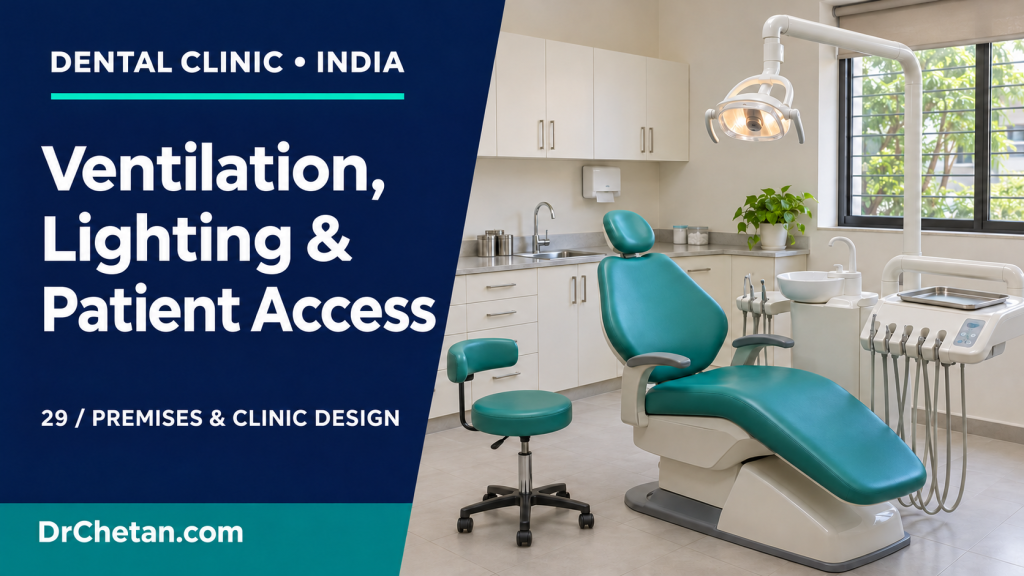
Dental Clinic India series · Article 29 · Premises & Clinic Design
Interior finishes shape more than the appearance of a dental clinic. They affect air movement, visibility, cleaning, staff work and whether a patient can use the service comfortably. Decisions about air conditioning, flooring and washbasins should be part of the clinical brief, not left until the decorative plan is complete.
Use this guide to prepare design and handover questions. Requirements depend on the premises and services; examples are not a substitute for applicable standards or a site assessment. Official reference material was reviewed on 25 November 2026.
Plan ventilation separately from cooling
India’s National IPC guidelines explain that ventilation dilutes and removes airborne contaminants, while a closed room with a split AC may lack adequate air exchange. Ask the ventilation professional how outdoor air, exhaust and the actual treatment activities are addressed. A comfortable temperature is not evidence of sufficient air exchange.
Record where air enters, where it leaves and what happens when doors or windows are closed during normal use. Consider the waiting area, operatory and processing area together. Review outdoor air quality, weather and neighbouring occupied spaces when choosing a natural, mechanical or mixed approach.
Understand the calculation before buying a fan
Worked illustration only: a room measuring 3.6 m × 3.3 m with a 3.0 m height has a volume of 35.64 m³. If a designer selected an illustrative target of eight outdoor-air changes per hour, the arithmetic flow would be 35.64 × 8 = 285.12 m³/hour. Eight is an example assumption here, not a recommended or statutory target for every dental room.
The designer must determine the applicable target and verify delivered performance. A fan’s catalogue rating is not necessarily its installed airflow after ducts, grilles and resistance are included. Recirculated air, filtered clean-air delivery and outdoor-air exchange are different quantities; do not substitute one number for another without the appropriate assessment.
| Design question | Evidence to request |
|---|---|
| What performance is required? | The applicable guidance and documented design assumptions |
| Where is air supplied and exhausted? | A layout showing routes and discharge points |
| What is actually delivered? | Appropriate commissioning measurements |
| How will it stay effective? | Filter, cleaning, inspection and maintenance arrangements |
| What changes affect performance? | Review triggers such as new partitions or another active chair |
Choose lighting for clinical work and movement
Assess the operatory with the dental light, room lighting and monitor operating together. Check for glare from glossy surfaces, shadows, reflections and difficult changes in brightness. Let the relevant designer and equipment instructions determine task-appropriate illumination rather than choosing fittings solely by appearance.
Include the processing inspection surface, reception paperwork, steps, signs and service cupboards in the lighting brief. A well-lit mouth does not compensate for a poorly lit instrument-checking counter. Arrange maintenance access so replacing a fitting does not require moving permanent equipment unnecessarily.
Select finishes that staff can maintain
Ask for durable, cleanable surfaces compatible with the cleaning and disinfecting products the clinic will use. Review joints, edges, cabinet bases and sink surrounds where water or dirt can collect. Choose slip performance and transitions appropriate to the area; the word “antiskid” on a sales label is not a complete specification.
Request a sample and the manufacturer’s care instructions before ordering large quantities. Test cleaning access around the proposed cabinetry. Avoid inaccessible gaps and decorative recesses that staff cannot realistically maintain between appointments or during the closing routine.
| Area | Practical finish check |
|---|---|
| Operatory floor | Safe movement, cleanability and no unnecessary trip transitions |
| Wet or cleaning area | Water resistance, drainage strategy and cleanable junctions |
| Clinical cabinetry | Compatible surfaces and access to handles and bases |
| Waiting area | Seating and finishes suited to regular cleaning |
| Walls and partitions | Durable treatment of contact and splash-prone surfaces |
Place washbasins around the workflow
Identify the hand-hygiene locations and supplies required by the clinical process. Plan instrument-cleaning and housekeeping functions separately so staff do not have to improvise conflicting uses at one basin. Coordinate water, drainage, tap operation, splash and service access before the counter is built.
Keep clean supplies protected from splash and provide a practical place for soap, hand-drying supplies and waste disposal. Check how staff approach the basin while the chair and assistant are in use. A basin hidden behind equipment or used as a storage shelf does not support consistent hand hygiene.
Assess the complete accessible patient route
The notified healthcare accessibility standards address private clinics, physical facilities and accessible service delivery. Have the appropriate designer apply the actual requirements for arrival, entrance, doors, circulation, reception, treatment and amenities. Do not copy a single ramp slope or toilet dimension without the rest of the standard’s conditions.
Include visual, hearing and communication needs in the service plan. Provide clear directions and a way to ask for help. Reception should be able to describe the clinic’s access accurately, and staff should discuss assistance with the patient rather than assuming what is needed.
Test the finished interior with real tasks
- Walk the patient route with normal furniture and doors in place.
- Check lighting at treatment, instrument inspection and circulation points.
- Verify ventilation in the conditions in which the clinic will actually operate.
- Run taps and inspect splash, leaks and access to supplies.
- Demonstrate cleaning around cabinets, chairs and equipment.
- Check that service access, emergency routes and accessible spaces remain clear.
Keep commissioning information and care instructions with the clinic’s maintenance schedule. Review the design after staff have worked in it, then correct recurring problems. Good interiors continue to support safe care after the opening photographs are taken.
More guides on opening and running a dental clinic
Implant Dentistry Setup: Training, Surgical Kits, Traceability and Referral Readiness
Orthodontic and Aligner Services: Equipment, Records and Consultant Arrangements
Paediatric Dentistry Starter Kit: Equipment, Materials and Behaviour-Support Needs
Local Anaesthesia Equipment and Supplies: A New Clinic’s Stocking Checklist
Restorative Dentistry Starter Kit: Instruments, Burs, Matrices and Materials
Root Canal Starter Kit: Files, Irrigation, Rubber Dam, Obturation and Restoration Supplies
Extraction and Minor Oral Surgery Kit: Instruments, Sutures and Haemostatic Supplies
Scaling and Periodontal Treatment Kit: Hand Instruments and Ultrasonic Tips
Crowns, Bridges and Dentures: Preparation, Impression and Laboratory Materials
New vs Used Dental Equipment: Supplier Checks, Device Compliance and Total Cost
Equipment Commissioning, Acceptance Checks, Maintenance Contracts and Breakdown Planning
Basic Examination and Diagnostic Instruments for a New Dental Clinic
Planning a Two-Chair Clinic: Privacy, Workflow and Shared Services
Loupes, Microscopes, Scanners, Lasers and Implant Motors: When an Upgrade Makes Sense
Planning a One-Chair Dental Clinic: Reception, Treatment, Sterilization and Storage
Designing a Sterilization Area: Dirty-to-Clean Instrument Flow
Dental Clinic Electrical, Plumbing, Drainage, Compressor and Suction Planning
Dental Clinic Signboards in India: Size, Wording, Qualifications and Local Permissions
Dental Clinic Equipment Checklist: Essential Purchases and What Can Wait
Choosing Your First Dental Chair: Features, Installation, Warranty and Service
Dental Compressors and Suction Systems: Capacity, Placement, Noise and Maintenance
Buying Dental Handpieces: Compatibility, Sterilization and Backup Requirements
Choosing an Autoclave and Instrument-Cleaning Equipment for a Dental Clinic
Intraoral X-Ray, RVG, PSP, OPG or CBCT: What to Own and What to Refer
Choosing Scalers, Curing Lights, Endomotors and Apex Locators
Renting Premises for a Dental Clinic: Lease Clauses, Landlord Consent and Due Diligence
Dental Operatory Dimensions: Chair Clearance, Assistant Space and Safe Movement
How Much Space Does a Dental Clinic Need? Legal Requirements vs Practical Planning
Residential vs Commercial Premises for a Dental Clinic: What to Verify Locally
What a BDS Dentist Can Offer: Specialist Titles, Training and Professional Boundaries
Can a Dentist Dispense or Sell Medicines? Storage, Prescriptions and Licensing Questions
Fire Safety, Accessibility and Building Compliance: What a Dental Clinic Must Check
AERB and eLORA for Dental X-Ray: Permissions from Purchase to Operation
Biomedical Waste Authorization and Waste-Collection Agreements for Dental Clinics
Municipal Permissions, Permitted Building Use and Shops and Establishments Applicability
Buying an Existing Dental Practice vs Starting a New Clinic
Moving to Another State to Practise Dentistry: Registration and Transfer Checks
Dental Registration in India: Internship Completion, State Registration and Renewals
Dental Clinic Registration in India: Central and State Laws Explained
Dental Clinic Paperwork: A Master Checklist of Documents and Authorities
Solo Practice, Partnership or Shared Clinic: Ownership and Agreement Essentials
Opening a Dental Clinic in India After BDS: The Complete Roadmap
Opening Immediately After BDS vs Gaining Experience First
Associate Dentist, Visiting Consultant or Clinic Owner: Choosing Your First Step
Are You Ready for Independent Dental Practice? A Clinical Skills and Referral Checklist
Choosing Courses and Mentors After BDS: Competence, Credentials and Scope of Practice
Choosing a City and Locality for Your First Dental Clinic
Writing a Dental Clinic Business Plan: Services, Costs, Capacity and Goals
Understanding Your Local Patients, Competition and Treatment Needs
Your Dental Clinic’s First 90 Days and First-Year Review: Launch Checklist and Common Mistakes
Expanding a Practice: Adding a Chair, Associate or Branch Without Losing Control
NABH Accreditation for Dental Clinics: Purpose, Preparation and When to Consider It
Patient Education, Community Outreach and Referrals Without Inducements
Setting Dental Treatment Fees: Materials, Lab Costs, Time and Complexity
Dental Clinic Accounting: Bank Accounts, Invoices, Receipts and Expense Records
GST for Dentists: Healthcare Exemptions, Cosmetic Services and Input-Tax Questions
Income Tax, TDS and Professional Tax: What to Discuss with Your Chartered Accountant
Funding a Dental Clinic: Savings, Loans, Equipment Finance and Working Capital
Deposits, Staged Payments, Patient Finance, Refunds and Outstanding Bills
Insurance for Dental Practices: Professional Indemnity, Equipment and Business Risks
Naming Your Dental Clinic and Building an Ethical Brand
Building a Dental Clinic Website and Accurate Online Listings
Handling Complaints, Treatment Complications and Requests for Refunds
Measuring Clinic Performance: Collections, Costs, Recall, Remakes and Patient Experience
Google Business Profile and Patient Reviews: Accuracy, Privacy and Professional Rules
Dental Social Media and Advertising in India: Current Rules and Practical Boundaries
Appointment Scheduling: Emergencies, Procedure Times, Cancellations and No-Shows
Dental Clinic Break-Even: Chair Time, Contribution, Cash Flow and Owner’s Drawings
Monthly Dental Clinic Running Costs: Rent, Salaries, Supplies and Hidden Expenses
How Much Does It Cost to Open a Dental Clinic in India? An Itemized Budget
Building Recall, Post-Treatment Follow-Up and Out-of-Hours Contact Systems
Choosing Practice Software: Records, Access Controls, Backups and Cybersecurity
Choosing a Dental Laboratory: Credentials, Work Orders, Quality and Remake Policies
Hiring and Training Your First Dental Assistant
Dental Inventory Management: Reorder Levels, Expiry Dates, Batches and Stock Control
Dentist and Assistant Ergonomics: Preventing Back Pain, Eye Strain and Work Injuries
The First Dental Consultation: Medical History, Examination and Diagnostic Records
Explaining Treatment Options, Costs and Prognosis Without Pressuring Patients
Informed Consent in Dental Practice: Procedures, Children, Language and Refusal
Dental Case Sheets, Treatment Notes and Record Retention in India
Dental Prescriptions and Letterheads: Required Particulars and Safer Prescribing
Patient Privacy, Clinical Photography and Consent for Sharing Cases
Medical Emergency Readiness: BLS Training, Emergency Equipment, Medicines and Transfer Plans
Treating Medically Complex Patients: Assessment, Medical Liaison and Referral Thresholds
Specialist Referrals and Clinical Handover: Records, Responsibility and Follow-Up
Adding Sedation or Advanced Procedures: Competence, Facility and Safety Requirements
Hiring a Receptionist: Calls, Triage Boundaries, Appointments and Patient Communication
Employing Clinic Staff in India: Contracts, Wages, Leave and Applicable Benefits
Working with Visiting Specialists: Agreements, Fees, Consent and Continuity of Care
Dental Clinic SOPs: Opening, Chair Setup, Turnover and Closing Checklists
Building an Infection-Control Programme for a Small Dental Clinic
Autoclave Monitoring, Sterilization Logs and Responding to a Failed Cycle
Instrument Reprocessing: Cleaning, Inspection, Packaging, Sterilization and Storage
Dental Handpiece Reprocessing and Safe Handling of Reusable Accessories
Needlestick Injuries, Occupational Exposure and Staff Vaccination Planning
Biomedical Waste Records, Reports, Pickup Tracking and Staff Training
Biomedical Waste Segregation in Dentistry: Sharps, Plastics, Teeth and Chemical Waste
Between-Patient Cleaning, Surface Barriers, Hand Hygiene and PPE
Dental Unit Waterlines, Suction Lines and Water-Quality Management

Leave a Reply